3D Design Renderings: A Carolinas Process Guide
Site survey, CAD draft, photoreal rendering, walk-through video — here's the design-build rendering deliverable Carolinas premium firms produce.

What You’re Actually Paying For When You See a “3D Backyard Design Rendering”
For premium Carolinas projects, a 3d backyard design rendering represents the difference between guessing at a vision and confirming an exact result. This deliverable serves as a structured process that exposes specific design issues long before expensive construction begins.
We see this tool as the ultimate risk management strategy for property investments. Matching with vetted luxury designers who use modern visualization software ensures you receive premium, verifiable output.
Accurate planning saves serious money.
By finalizing every detail digitally, clients avoid mid-project changes that derail budgets.
Step 1: Site Survey
Before any design work starts, the firm documents reality with exact measurements. We start every project by capturing accurate baseline data to prevent costly errors later.
Modern site surveys rely on specific data points to build a reliable foundation for any premium 3d landscape design Carolinas project.
- Topography mapping for slopes, grade changes, and drainage patterns
- Exact utility locations for gas, water, electric, and septic lines
- Existing structural footprints including decks and fences
- Mature trees plotted with exact caliper measurements
- Setbacks, easements, and HOA-mapped restrictions
Our surveying teams typically deploy RTK drone technology to scan the property. This 2026 drone technology achieves incredible 1-to-3 centimeter accuracy in a fraction of the time manual methods require. Using LiDAR sensors on these drones also allows designers to map ground elevations straight through dense vegetation.
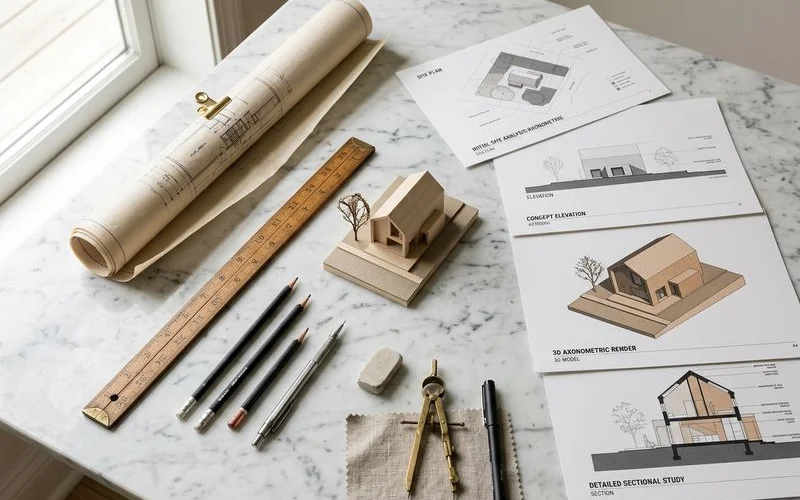
Step 2: CAD Draft and Master Plan
The master plan phase converts survey data into a clear 2D schematic. This flat drawing maps out the spatial relationship of every proposed feature.
We use this crucial step to lock in the fundamental layout before adding expensive 3D textures. The designer produces a 2D master plan detailing several key zones.
- All hardscape elements like patios, decks, and outdoor kitchens
- Precise pool deck configurations and water feature placements
- Plant beds and specific tree locations
- Lighting fixture positions and electrical routing
- Clear paths and circulation routes for foot traffic
These blueprints go through one or two review rounds with the homeowner. Adjustments at this early 2D stage cost almost nothing to execute. Changing a patio layout after full 3D modeling takes much more time, while moving a poured concrete wall during construction creates severe financial penalties.
Step 3: 3D Modeling
The designer builds a comprehensive 3D model directly from the approved CAD master plan. We use this stage to assign exact physical materials to the wireframe shapes.
Material accuracy dictates the true value of the final image. A reliable model includes highly specific product selections.
- Exact paver products like Belgard Mega-Lafitt or Techo-Bloc Travertina
- Specific composite decking choices such as TimberTech AZEK in Coastline
- Precise plant species modeled at their mature height and width
- Specific lighting hardware like Brilliance Brass Path Lights
- Natural stone veneers matching Eldorado Cliffstone in Carolina Topaz
Our team relies on manufacturer-provided digital assets to guarantee exact color representation. Seeing the precise texture of a $15,000 retaining wall material before purchasing it gives property owners absolute confidence.
Step 4: Photoreal Rendering
Modern rendering engines generate images that rival actual photographs of the finished site. We transform the basic 3D model into a polished presentation using industry-leading software.
Top-tier firms utilize specific programs based on the project requirements.
- Lumion: The 2026 update features advanced ray-tracing technology with over 2,500 physically accurate nature objects for absolute realism.
- Twinmotion: Powered by Epic Games, this tool excels at real-time lighting adjustments and direct CAD synchronization.
- D5 Render: A modern alternative praised for exceptionally high-quality lighting in residential spaces.
Our designers typically render four to eight distinct viewpoints to capture the entire property. These standard angles include a main backyard hero view, a pool deck close-up, an overhead aerial perspective, and a dedicated evening lighting view.
Lighting simulations provide incredible value by showing the exact shadows cast at different times of the day.
Step 5: Revisions
Most premium Carolinas firms include two to three revision rounds directly within their standard design fees. We consider this phase the highest return on investment in the entire design rendering process.
Industry data from 2025 shows that thorough 3D planning and revisions boost project savings by 10 to 20 percent by eliminating material waste. Common adjustments during this phase are incredibly practical.
- Shifting an outdoor kitchen layout to improve the cooking workflow
- Swapping a paver pattern after viewing its true scale against the house
- Increasing or decreasing the density of planting beds
- Adjusting the placement of evening lighting fixtures
Making a layout change inside a computer model takes an hour of a designer’s time. Waiting to discover that same layout issue during the physical build requires expensive demolition and costly new material orders.
Step 6: Walk-Through Video
Premium firms generate an animated walk-through video lasting 60 to 90 seconds. We use this dynamic presentation to simulate walking through the finished space at human eye level.
These digital tours deliver a realistic sense of scale and traffic flow that static images simply cannot match. Advanced software like Twinmotion even allows designers to hook up a VR headset for a fully immersive client experience.
Walk-through videos provide massive clarity for specific scenarios.
- Multi-feature properties where transition zones are critical
- Sloped sites featuring dramatic elevation changes
- Complex lighting designs requiring a full day-to-night cycle demonstration
- Large-scale commercial developments needing investor approval
Our clients consistently report that video tours eliminate any lingering anxiety about spatial dimensions.
What This Costs
Full 3D rendering packages generally account for 5 to 15 percent of the total project budget when integrated into a design-build firm’s fees. We find that standalone residential rendering services carry distinct price tags based on complexity.
Commercial exterior renderings and multi-building developments demand higher rates, often pushing past $5,000 per image. For animated video walkthroughs, high-end production costs scale rapidly based on duration and complexity.
| Service Type | Estimated 2026 Cost Range |
|---|---|
| Standalone Residential Image | $1,000 - $3,000 per view |
| Commercial Exterior Image | $2,000 - $5,000+ per view |
| Animated Walk-Through Video | $8,000 - $15,000+ per minute |
Our financial models show that these design fees pay for themselves rapidly through absolute risk reduction.
If you commission a $200,000 backyard renovation, a $20,000 design and rendering fee acts as an insurance policy against construction-phase change orders. Paying a designer to get the exact layout right is significantly cheaper than paying a contractor to tear out a finished patio.
When Rendering Is Worth It
A complete 3d backyard design rendering generates the most value on complex properties with total scopes exceeding $100,000. We recommend this process specifically when multiple outdoor systems must integrate perfectly together.
Investing in high-end visualization makes sense for several specific project types.
- Properties requiring combined kitchen, pool, and structural installations
- High-end aesthetics demanding a magazine-quality finish
- Phased deliveries where year-one work must align with year-three additions
- Sites with challenging topography requiring extreme grading accuracy
These advanced visual tools become unnecessary for single-feature, small-scope jobs like a basic $30,000 patio refresh or a standalone pergola installation.
Our team approaches design and construction as one continuous process. For a deeper understanding of this methodology, read our design-build vs traditional guide to see how proper planning prevents execution errors. Premium design-build firms utilize rendering as a standard protective measure, while traditional contractors rarely offer this level of digital foresight.
3D Design Renderings: What to Expect from the Process: Common Questions
How much does 3D rendering cost?
Carolinas premium design-build firms typically include rendering in design fees; standalone rendering services run $1,500-$5,000+ depending on yard size. As a fraction of total project, rendering is one of the higher-ROI design expenditures.
How accurate are the renderings?
Photoreal level accuracy on materials, plant species, lighting time-of-day — what you see is what you get within design-tolerance limits. Modern rendering engines (Lumion, Realtime) produce client-presentation-grade output.
Can I make changes after rendering is done?
Yes, within scope. Most design contracts include 2-3 revision rounds; major redesigns trigger additional design fees. The point of rendering is to surface changes before construction, not to prevent them.
Ready to talk to luxury backyard design contractors?
Get matched with vetted Carolinas luxury backyard design specialists. Free, no-obligation quotes within 48 hours.
Free • No-obligation quotes • Vetted Carolinas contractors only