Composite vs Pressure-Treated Decking: A Carolinas Comparison
Composite costs more upfront but wins long-term. Here's the honest Carolinas comparison — total cost, maintenance, ROI, slip resistance.
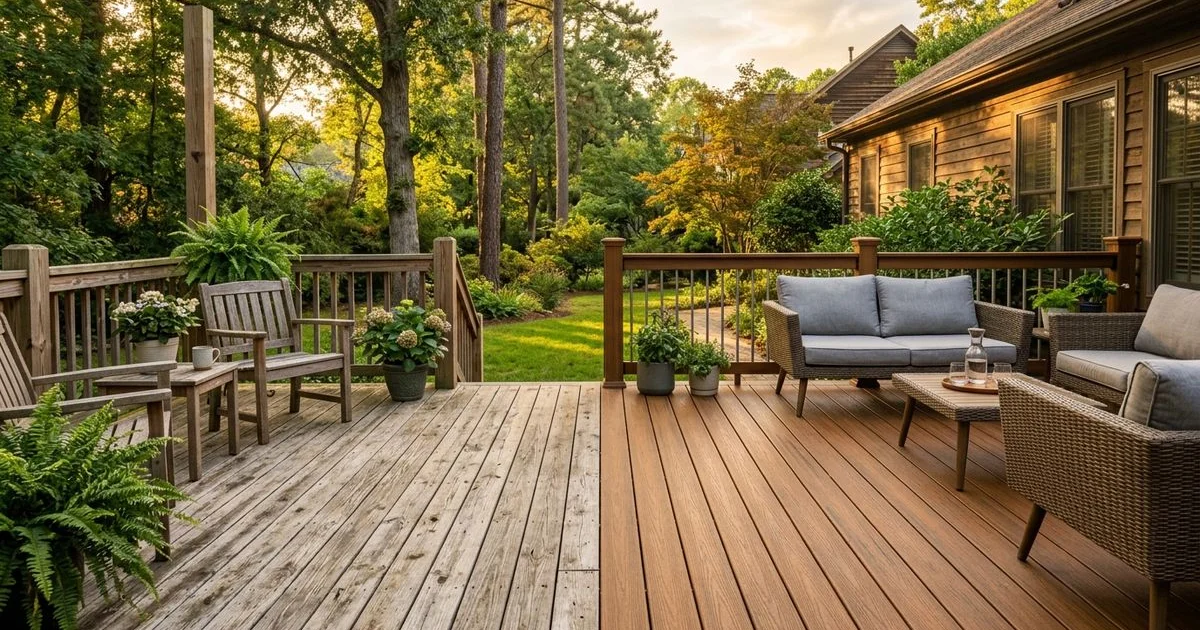
The Material Choice Most Carolinas Buyers Get Wrong: Composite vs Wood Deck
Our team often notices that the most expensive outdoor living mistake happens during the initial material selection. Choosing between a composite vs wood deck is actually a 20-year math problem disguised as a simple upfront purchase.
We see pressure-treated lumber selected for its low initial price tag all the time. The 2024 Cost vs. Value report by Remodeling Magazine even shows a wood deck in the South Atlantic region recoups about 78 percent of its cost, which looks great on paper.
We know that number assumes the wood survives the harsh local climate without rotting.
Let’s look at a few core factors:
- Actual Maintenance Data: The real cost of staining and sealing.
- Upfront Cost Comparisons: The exact price difference today.
- Ownership Timelines: How your long-term plans dictate the right material.
We suggest you get vetted deck builder matches to quote both options to see real Carolinas pricing for your specific configuration.
A local quote brings this entire comparison into sharp focus.
Upfront Cost
The primary difference in upfront cost comes down to the manufacturing process and material lifespan. Pressure-treated Southern Yellow Pine remains the most affordable decking material available in the Carolinas.
We typically see builders use wood treated with Micronized Copper Azole (MCA) to protect against local termite populations. Comparing a composite vs pt deck reveals a meaningful price gap upfront.
Here is a quick breakdown of typical 2026 installed prices for a standard 300-square-foot project:
| Material Tier | Estimated Cost per Sq Ft | Total Project Estimate |
|---|---|---|
| Pressure-Treated Wood | $15 - $25 | $4,500 - $7,500 |
| Mid-Tier Composite | $25 - $40 | $7,500 - $12,000 |
| Premium Composite | $45 - $70 | $13,500 - $21,000 |
Our team estimates mid-tier composite boards, like Trex Enhance or TimberTech Reserve, sit solidly in the middle of this pricing spectrum. The premium tier includes advanced PVC materials that resist heat and scratches much better than entry-level synthetic boards.
We understand the composite price tag causes some sticker shock. The gap is certainly meaningful, but the numbers look very different when you stretch them across two decades.
Maintenance Reality
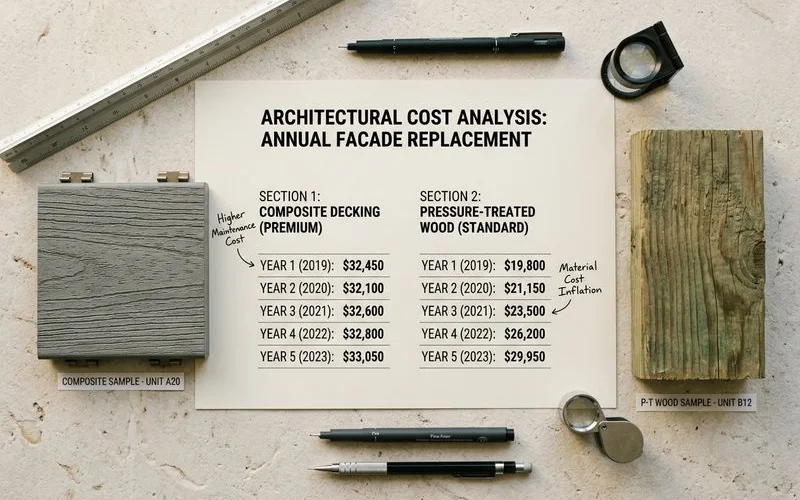
The reality of owning a wood deck is that the maintenance never truly ends. Pressure-treated wood requires a fresh coat of sealant every two to three years to prevent moisture penetration and cracking.
We reviewed 2025 data from Angi showing that a professional deck staining service in North Carolina averages between $550 and $1,250 per visit. Products like Cabot or Ready Seal perform well, but they still degrade under constant sun exposure.
Three maintenance paths exist for traditional wood:
- Professional Servicing: Hiring a crew costs $550 to $1,250 every few years.
- The DIY Route: Homeowners spend $150 to $300 on stains and brushes, plus a full weekend of hard labor.
- Skipping Maintenance: Ignoring the wood cuts the deck’s structural lifespan down to 10 or 15 years.
We value composite decking specifically for its near-zero maintenance requirements. You never need to sand, stain, or seal synthetic boards.
The modern formulations use a protective polymer cap to prevent fading and lock out moisture entirely. Your only real maintenance is an occasional rinse with a garden hose to clear away dirt.
We calculate the 20-year maintenance cost of a wood deck easily hitting $4,000 to $8,000 for professional care. That same upkeep cost for composite is virtually zero.
Aesthetics
The initial aesthetic appeal of new pressure-treated pine is undeniable. The natural wood grain brings a lot of warmth to an outdoor space.
We always warn property owners that this golden color fades quickly without aggressive sealing. The wood weathers to a silvery gray after just a few seasons, and knots or splits inevitably begin to appear.
The visual advantages of modern composite solve these exact deterioration issues:
- Deep Embossing: High-pressure compression creates realistic cathedral grain patterns.
- Defect-Free Surfaces: You will never find an ugly knot or structural split.
- Multi-Tonal Colors: Premium lines blend up to six pigments to mimic exotic hardwoods.
We highly recommend collections like Trex Lineage or TimberTech Vintage if you want the look of ipe or mahogany. You get the high-end appearance without the constant staining requirements.
Carolinas Humidity Reality
The humid climate across the Carolinas aggressively punishes standard decking materials. The average humidity in states like North Carolina frequently hovers above 70 percent.
We see this moisture cause constant expansion and contraction in traditional wood framing. The persistent dampness encourages mold growth in shaded areas.
The local environment presents three distinct threats to outdoor structures:
- High Humidity: Constant moisture absorption causes wood to warp and cup.
- Heavy Pine Pollen: The sticky spring dust requires aggressive pressure washing.
- Coastal Salt Air: Regions like Cape Fear and the Lowcountry face accelerated rot from salt exposure.
We find that composite boards completely shrug off these regional environmental stressors. The solid polymer core and protective capping block moisture absorption completely.
Modern synthetic options handle salt and pollen effortlessly. You can easily wash the deck down without driving water into vulnerable wood fibers.
Slip Resistance
Safety around wet surfaces is a major concern for any property owner. Modern textured composites now match or even exceed the slip ratings of traditional pressure-treated wood.
We always check the Coefficient of Friction ratings when comparing materials. The Occupational Safety and Health Administration recommends a minimum wet COF rating of 0.5 for safe walking surfaces.
Specific safety solutions for wet areas include:
- Premium Textured Composites: Lines like Trex Transcend often exceed the 0.5 COF minimum.
- Deep Grain Embossing: Physical texture molded into the board provides mechanical grip.
- Grit-Additive Sealants: These can be applied to traditional wood for extra traction.
We advise paying close attention to these ratings if you are building adjacent to a pool. The splashing water makes slip resistance absolutely critical for barefoot traffic.
Smooth, older-generation composite boards from a decade ago were notoriously slippery. You should verify the specific product specifications to guarantee a safe deck surface today.
Heat in Summer
The summer sun dramatically impacts how comfortable your deck feels underfoot. Dark composite boards naturally absorb and retain thermal energy.
We measure surface temperatures on dark synthetic boards reaching between 130 and 150 degrees Fahrenheit during peak Carolinas afternoons. That level of heat makes walking barefoot incredibly uncomfortable.
Several effective strategies exist to combat excessive deck heat:
- Lighter Color Palettes: Soft tans and light grays reflect solar radiation.
- Advanced PVC Materials: Products like TimberTech AZEK stay up to 30 degrees cooler than standard composites.
- Strategic Shading: Adding pergolas or sail shades cools the surface down quickly.
We always remind clients that traditional pressure-treated wood maintains a fairly moderate temperature. The natural cellular structure of wood does not trap heat the same way dense plastic does.
You must spec your materials carefully based on your yard’s sun exposure. This simple planning step guarantees the space remains usable in July and August.
ROI in Carolinas Markets
A well-built deck provides a strong financial return when you decide to sell your home. Premium composite decks consistently appraise higher than wood in affluent Carolinas markets like Charlotte, Raleigh, and Lake Norman.
We look at the 2024 Remodeling Magazine data to guide these financial conversations. The report indicates that a wood deck addition in the South Atlantic region recoups roughly 78 to 85 percent of its initial cost.
Here is how the resale value typically breaks down:
- Wood Decks: High percentage return on a lower initial investment.
- Composite Decks: Slightly lower percentage return, but higher total dollars added to the home’s value.
- Rental Properties: Starter homes and rentals often benefit most from the low upfront cost of wood.
We find that the maintenance-free narrative is a massive selling point for modern homebuyers. A pressure-treated deck older than ten years frequently shows up on inspection reports as deferred maintenance.
This neglected wood actively depresses home value and scares away potential buyers. A 10-year-old Trex deck still looks brand new and requires zero apologies during an open house.
The Honest Recommendation
For homes you plan to own for seven or more years, composite decking almost always wins the total cost of ownership battle. The superior aesthetics and lack of maintenance make it the smartest long-term investment.
We find the mid-tier options, like Trex Enhance or TimberTech Reserve, represent the perfect sweet spot for most suburban projects. You get the reliable polymer capping without the extreme premium price tag.
Your final material choice usually comes down to these two scenarios:
- Short-Term Ownership: Pressure-treated pine works best if you plan to move within five years.
- Long-Term Investment: Composite pays for itself in maintenance savings over a decade.
We stress that the framing and structural supports are identical regardless of the surface boards you choose. Proper installation requires heavy-duty lateral-load connectors, like the Simpson Strong-Tie DTT2Z, to meet local building codes.
Please review our deck-build process guide for the full timeline and next steps.
Speak with a vetted local contractor today to lock in your chosen Carolina deck material and get your project on the schedule.
Composite vs Pressure-Treated Wood Decking: Common Questions
Does composite cost twice as much as PT?
Roughly — installed mid-tier composite runs ~50-80% more than PT in the Carolinas; over 20 years, total cost gap closes substantially due to PT's maintenance and replacement cycle.
Will PT deck rot in NC humidity?
Modern micronized copper PT lasts 15-25 years if maintained (sealed every 2-3 years). Without maintenance, 10-15 years is typical. Carolina humidity, treed lots, and pollen accelerate degradation if maintenance lapses.
Is composite slippery when wet?
Modern textured composites (TimberTech, Trex Transcend) match or exceed PT slip ratings. Smooth vintage composites can be slick — check the product spec. Lighter-color composites also stay cooler underfoot in summer.
Ready to talk to decks contractors?
Get matched with vetted Carolinas decks specialists. Free, no-obligation quotes within 48 hours.
Free • No-obligation quotes • Vetted Carolinas contractors only