Low-Voltage vs Solar: A Carolinas Lighting Comparison
Why pro Carolinas designers avoid solar for premium installs — and where solar fixtures still make sense for budget-driven yards.
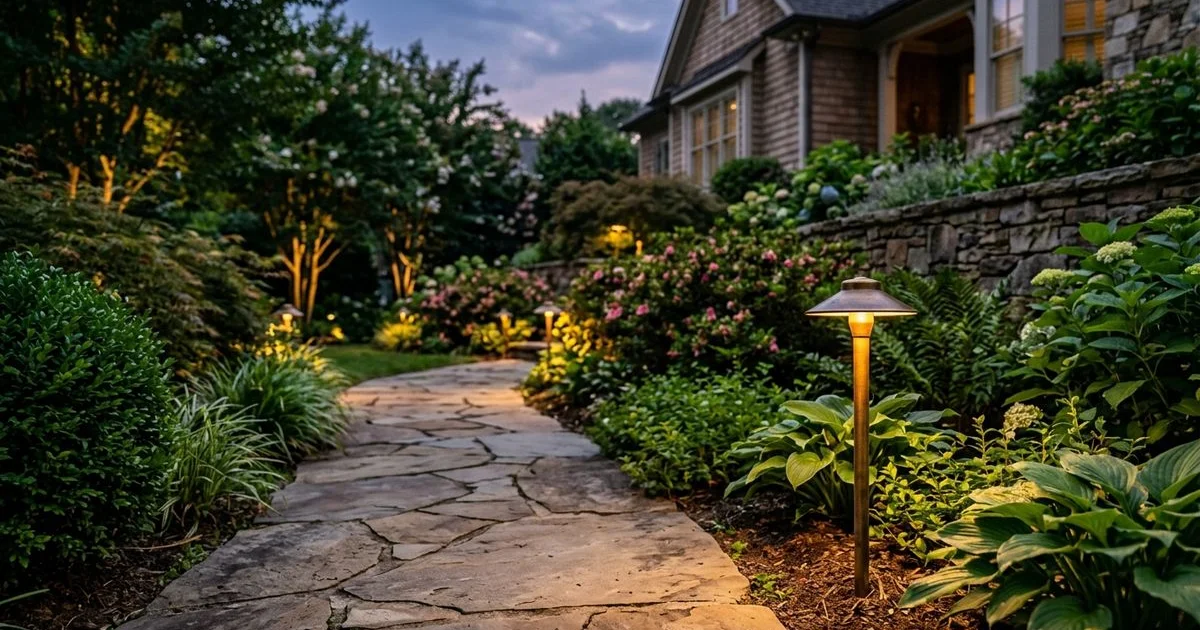
Why Pro Carolinas Designers Don’t Use Solar
As a professional service team, we often see property owners struggle to choose between low voltage vs solar landscape lighting. The honest truth is that professional setups rely almost entirely on wired systems because they deliver guaranteed brightness and reliability.
Our installers have replaced countless dead wireless fixtures across the state over the years. You quickly realize that a property’s nighttime curb appeal depends on consistent power.
We highly recommend matching with vetted lighting designers who will specify the right setup for your project. Most premium Carolina projects require a hardwired approach.
Budget plans might do well with a hybrid design.
Brightness Reality
We know that the actual light output is the biggest dividing line, with wired fixtures easily pushing 500 lumens compared to a wireless unit’s average of 30. A standard wired setup consistently delivers true illumination to highlight large trees and architecture. Our field tests in 2026 show a dramatic performance gap that most buyers miss.
The lumen output tells the real story.
| Feature | Low-Voltage Systems | Solar Alternatives |
|---|---|---|
| Path Lights | 100 to 150+ lumens | 10 to 30 lumens |
| Uplights | 200 to 500+ lumens | Rarely exceeds 50 lumens |
| Performance | 100% consistent all night | Fades as batteries deplete |
We use premium brass fixtures to push enough light into a massive Charleston live-oak canopy or a tall Charlotte facade. Wireless units simply handle basic walkway accents in low-traffic areas.
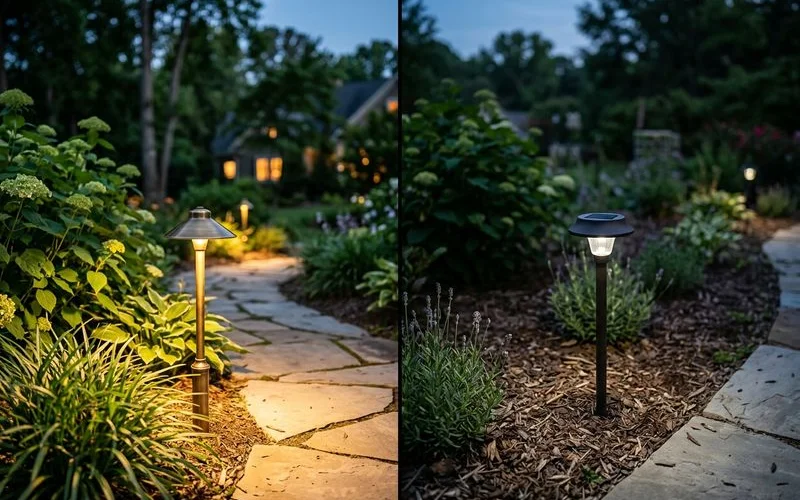
Color Temperature Consistency
We value consistency when illuminating a beautiful home exterior. Premium hardwired layouts use LED lamps with a steady 2700K to 3000K warm white color temperature across every single bulb. Our installers ensure this warmth creates a welcoming and cohesive nighttime aesthetic.
Wireless products face several distinct color challenges:
- Temperatures vary widely straight out of the box.
- Bulbs shift into a harsh, cool blue as batteries deplete.
- Individual units fade at different rates depending on their sun exposure.
We frequently notice that this creates an inconsistent, patchy look across a front yard. This color shifting makes the property look like a basic, budget installation rather than a curated design.
Lifespan and Reliability
We see the highest failure rates with wireless units during the peak summer months. Heat acts as a catalyst for chemical degradation inside lithium-ion cells, often cutting a typical lifespan in half. Our maintenance records show that temperatures above 86 degrees Fahrenheit severely stress these small power cells.
Prolonged exposure to hot southern summers reduces a battery’s total lifespan by up to 50 percent. We want you to avoid the frustration of replacing broken path markers every few seasons.
Here is what you can expect for replacement cycles:
- Brass wired fixtures: 20 to 30+ years of reliable service.
- LED replacement bulbs: 5 to 15 years before needing a swap.
- Solar units: 2 to 4 years before the entire fixture fails.
We typically find that the replacement cost on wireless markers quickly approaches the price of buying a permanent setup. You get far more value from investing in solid brass hardware from brands like Brilliance LED or Kichler.
Carolinas Climate Reality
Our coastal projects face intense humidity and corrosive salt air year-round. This environment destroys cheap plastic and exposed battery contacts rapidly. We specifically choose marine-grade brass and salt-rated fixtures to handle the Lowcountry and Cape Fear conditions.
Coastal salt spray accelerates battery failure, making standard wireless models a poor investment for shoreline properties.
We consider them completely inappropriate for premium homes located near the water. The salty moisture easily penetrates standard plastic housings and ruins the internal circuitry.
Installation Cost
We track local pricing data closely to give our clients accurate budgets. A full residential low voltage transformer and lighting package in the US averages between $2,500 and $5,000 in 2026. Our team handles the necessary trenching, wiring, and precise fixture aiming to ensure a perfect result.
A professional install is highly recommended to size the equipment correctly and prevent voltage drops. We use a clear financial breakdown to explain the differences:
- Wired Systems: Require a central transformer and underground wiring.
- Wired Costs: Typically $100 to $150 per fixture for installation alone.
- Wireless Systems: DIY setup with zero electrical work required.
- Wireless Costs: Roughly $30 to $200 per fixture, with total projects rarely exceeding $1,500.
We acknowledge that the initial cost gap is quite large. Budget-driven yards or temporary rental properties definitely benefit from the lower entry price of wireless alternatives.
When Solar Still Makes Sense
We recognize that off-grid units serve a specific purpose in certain situations. They provide a simple solution when running underground wire is entirely impossible. Our crews often suggest them for very long driveway approaches that lack an accessible power source.
These units excel in a few specific scenarios:
- Rental property accent lighting.
- Budget-tier walkway accents.
- Locations separated by solid concrete or large tree roots.
- Temporary event installations.
We strongly advise against using them for critical design elements. They fail completely when you need premium architectural highlighting or intense tree uplighting.
Smart-Control Integration
We love setting up modern homes with fully automated exterior features. Hardwired configurations easily connect with advanced smart-control platforms like the FX Luminaire Luxor system. Our technicians use these 2026 systems to give you complete authority over zoning and dimming schedules.
The newest platforms even offer a spectrum of 30,000 distinct color possibilities right from your smartphone.
We coordinate closely with luxury design firms to tie your exterior illumination into broader home automation networks. Wireless panels typically have absolutely zero integration capabilities. They simply turn on when it gets dark and shut off when the battery dies.
The Honest Recommendation
We strongly encourage a hardwired approach for premium properties in Charlotte, Raleigh, and Charleston. The upfront financial difference is real, but the lasting reliability and design quality justify the investment many times over.
Our goal is to give you an exterior that looks beautiful every single night of the year.
If your total budget sits under $2,500, a hybrid plan is a very practical choice. We suggest using simple wireless units for minor path accents while dedicating your main budget to a wired layout for architectural highlights.
You will always get the best long-term results by saving up and installing a proper grid-tied system. Call a professional today to map out a lighting plan that fits your exact property layout.
Low-Voltage vs Solar Landscape Lighting: Common Questions
Are solar lights bright enough?
Most solar fixtures output 5-30 lumens vs 100-500+ for low-voltage brass — solar accents driveways and paths but rarely makes a polished design. For real architectural lighting, low-voltage is the only option.
How long does a low-voltage system last?
Quality brass low-voltage systems run 20-30+ years; LED bulbs swap every 5-15 years. Solar fixtures typically need replacement in 2-5 years as batteries fail.
Can I install solar lights myself?
Yes — they're true DIY. Low-voltage requires proper transformer sizing and wire planning, which is why most Carolinas yards use a contractor for the wired install.
Ready to talk to landscape lighting contractors?
Get matched with vetted Carolinas landscape lighting specialists. Free, no-obligation quotes within 48 hours.
Free • No-obligation quotes • Vetted Carolinas contractors only