When Carolinas Retaining Walls Need Engineered Drawings
NC and SC require engineered drawings for retaining walls over 4 ft (with exceptions). Here's the rule, the surcharge factor, and what failure looks like.
What Are the Retaining Wall Engineering Requirements Most Buyers Don’t Know?
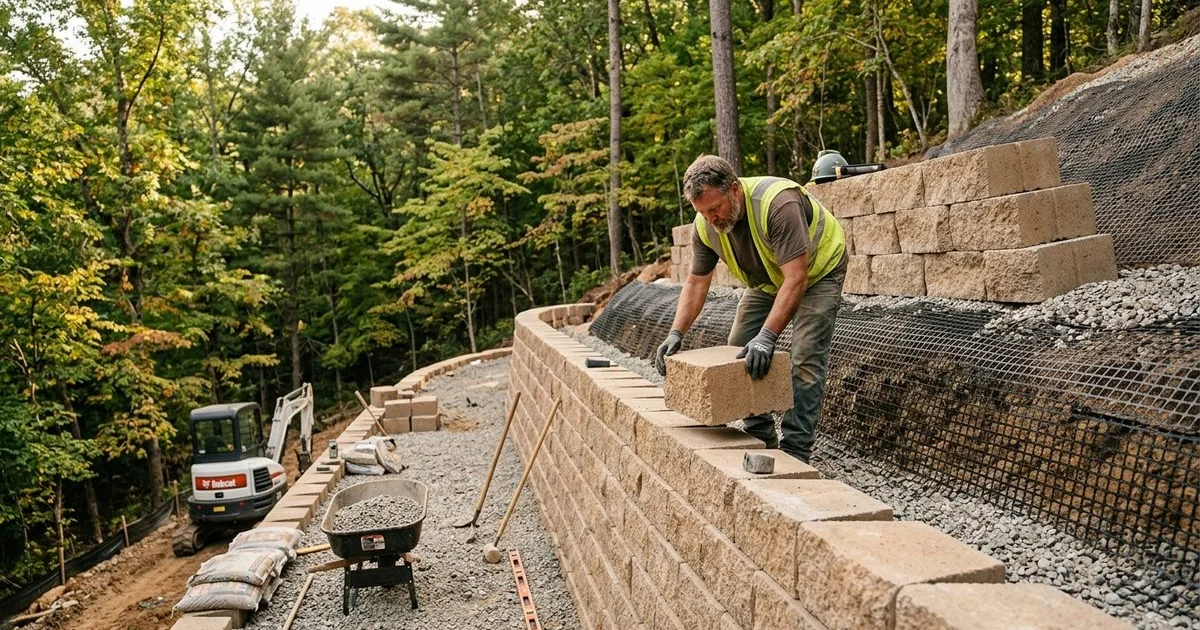
Our crews talk to property owners every week who misunderstand local building codes. Meeting strictly enforced retaining wall engineering requirements is the dividing line separating a simple weekend project from a serious structural liability. We have inspected dozens of failed residential retaining walls across NC and SC, and almost all of them lacked stamped drawings from a licensed Professional Engineer.
If you are planning a wall, talk to vetted retaining wall contractor matches early. Our advice is to have them evaluate your site immediately for surcharge factors and county permit rules.
Getting this structural assessment right saves thousands of dollars in the long run.
The 4-Foot Threshold
Most jurisdictions, including Mecklenburg and Buncombe counties, default to PE-required engineering at 4 feet of exposed wall height. We always remind clients that inspectors measure this from the bottom of the buried footing to the top of the wall. This means a wall showing only 3.5 feet above ground still triggers a retaining wall permit NC code enforces if it has a 6-inch buried base.
Below that strict threshold and without extra weight, segmental block systems like Versa-Lok, Allan Block, Belgard, and Techo-Bloc can usually be installed without engineered drawings. Our local code enforcement offices watch exposed height closely on sloped properties. A 6-foot total wall with 2 feet buried is still legally an exposed 4-foot structure, meaning engineering is required.
We see homeowners get caught off guard when a wall stepped down a hill triggers engineering at its tallest section, even if the rest of the run is much shorter.
The Surcharge Factor: Often Missed
Surcharge load is any heavy object bearing on the soil directly behind the wall. Our structural designs must account for anything pushing extra weight laterally, such as a new paver driveway, pool deck, or vehicle parking area. This added weight dramatically increases the horizontal pressure, creating a massive risk of blowouts.
We often see the engineering threshold drop to 2 feet or below when surcharge loads are present. Local building inspectors look for these common Carolina surcharge examples:
- Walls sitting below a driveway turning area.
- Hardscaping placed under a pool deck.
- Structures holding back an outdoor kitchen footing or pergola post.
- Earth retained near a heavy structure like a deck, addition, or garage.
Our rule of thumb is the 1-to-1 ratio. If a concrete slab sits within a horizontal distance equal to the wall’s height, the structure has a surcharge.
What Engineering Actually Buys You
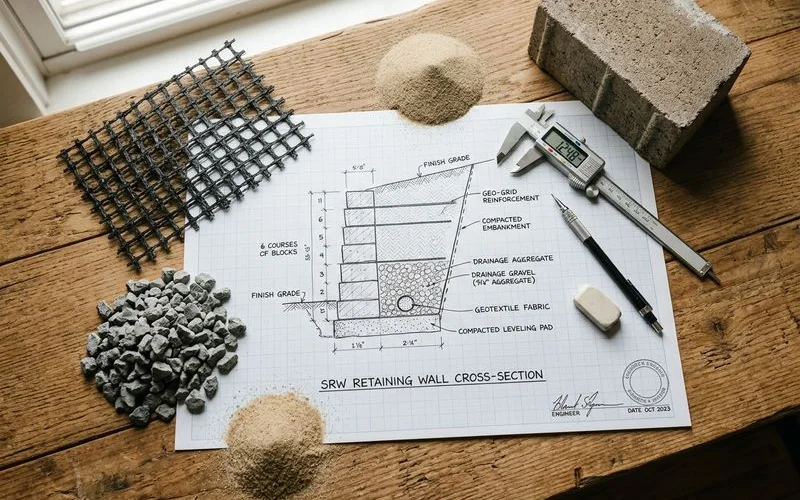
A stamped PE drawing provides a strict blueprint designed to achieve a standard 1.5 Factor of Safety against lateral sliding and overturning. Our teams follow these plans to ensure your project survives the estimated 43 inches of annual rainfall common in the Charlotte metro area. Engineers mandate four critical specifications to prevent hydrostatic pressure from destroying the installation.
| Engineering Specification | Structural Purpose |
|---|---|
| Geogrid Reinforcement | Prevents the soil mass from slumping and bowing the wall center outward. |
| Aggregate Base Depth | Uses 6-12 inches of compacted #57 stone to stop uneven block settling. |
| Drainage Details | Employs perforated pipe and clean gravel backfill to relieve heavy hydrostatic pressure. |
| Wall Cap Adhesives | Seals the top course tightly to prevent water intrusion and loose stones. |
We consider skipping any of these steps the primary reason walls fail. Carolinas clay holds a massive amount of water. Our local soil turns into a heavy liquid during late summer storms, pushing unreinforced structures until they snap.
Carolinas Soil Reality
Piedmont red clay, specifically Cecil clay found around Charlotte, Greensboro, and Raleigh, acts like a sponge. We constantly battle this soil because it expands forcefully when wet and contracts into hard concrete when dry, causing severe lateral load cycling. Upstate SC granite-rock soils complicate basic excavation and require heavy equipment to manage.
Our teams working in the Blue Ridge mountains must account for frost heave caused by winter freeze-thaw cycles. Lowcountry sandy soils present a completely different challenge, needing specialized drainage details to prevent washouts. We rely on site-specific soil testing to tell the engineer exactly what materials will keep your yard stable.
What Failure Looks Like
When an unengineered structure fails, it happens quickly and dangerously. Our repair crews routinely get called out to fix common failure modes across the Carolinas. These issues usually stem from taking shortcuts on base preparation and drainage gravel.
- Bowing: The center pushes outward because geogrid reinforcement layers are missing.
- Leaning: The face tips forward due to trapped hydrostatic pressure from poor back-drainage.
- Settling: Blocks drop unevenly because the compacted aggregate base was too thin.
- Collapse: Total structural blowout occurs under saturated soil conditions.
We remind clients that repairing a collapsed structure typically costs far more than building it correctly the first time. Demolition and disposal alone can add $20 to $30 per linear foot to your total bill, and insurance policies generally exclude unengineered construction defects.
Cost: The PE Stamp Pays Back
In 2026, professional fees for an engineered retaining wall SC and NC properties need average between $1,500 and $4,000 for the stamped plans. Our financial breakdown shows this is a small percentage of a comprehensive outdoor renovation. For walls integrated with patio or pool deck work, design-build firms often coordinate these fees directly into the master design.
We also navigate strict local ordinances, like Spartanburg County requiring a licensed third-party Special Inspector for walls over six feet tall. The right vetted contractor will accurately assess your property and route the permits through a qualified engineer. We warn against cheap bids from contractors who skip compliance, leaving you holding a useless warranty when the soil shifts.
Following retaining wall engineering requirements at the design phase guarantees a permanent solution. Engineered retaining walls are built to last 50 years, while unengineered shortcuts rarely survive five.
Reach out to a certified professional today to get your yard safely secured.
When Does a Retaining Wall Need an Engineer?: Common Questions
Is a 3.5-foot wall safe to build without an engineer?
Without surcharge loads, often yes. With a driveway, pool, or structure above, walls under 4 ft can still need engineering. Many Carolinas counties default to PE-required at 4 ft, but local code may set thresholds lower.
How much do engineered drawings cost?
Carolinas structural-engineering fees for residential retaining walls run $800-$2,500 depending on complexity. The fee pays back many times over by preventing the failure modes typical of unengineered work.
Can my contractor draw it themselves?
No — most NC and SC counties require a licensed PE stamp on retaining wall drawings above the threshold. A general contractor cannot self-certify the engineering.
Ready to talk to retaining walls contractors?
Get matched with vetted Carolinas retaining walls specialists. Free, no-obligation quotes within 48 hours.
Free • No-obligation quotes • Vetted Carolinas contractors only